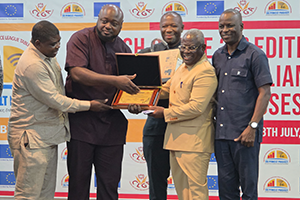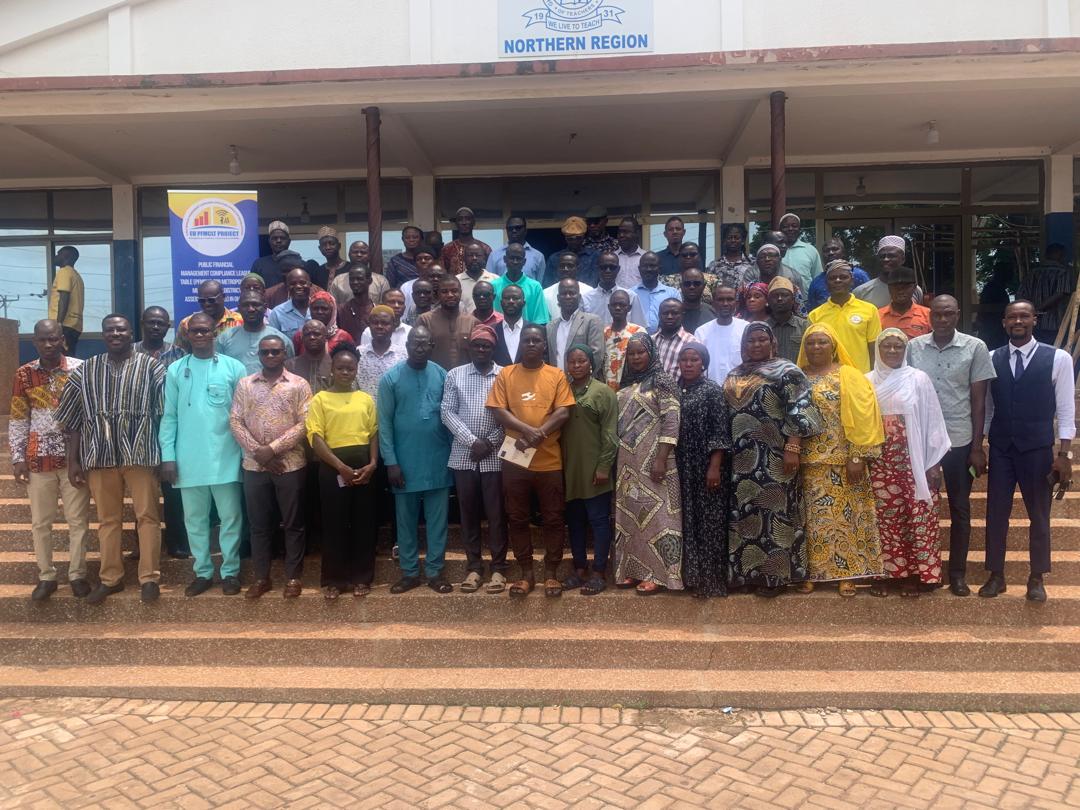
For many residents of Kintampo, questions about how much revenue their Assembly generates and how those resources are spent have long remained unanswered. On 14 July, 2026, however, citizens were given an opportunity to seek those answers firsthand during a town hall meeting organized by the Centre for Local Governance Advocacy (CLGA) with funding support from the European Union.
The meeting, held in Kintampo in the Bono East Region, formed part of CLGA's nationwide dissemination of the 2025 Public Financial Management Compliance League Table (PFMCLT) findings. The event brought together over 100 participants, including representatives of the Kintampo Municipal Assembly, traditional authorities, civil society organizations, women's groups, youth leaders, persons with disabilities, community members, and the media.
For many residents of Kintampo, questions about how much revenue their Assembly generates and how those resources are spent have long remained unanswered. On 14 July, 2026, however, citizens were given an opportunity to seek those answers firsthand during a town hall meeting organized by the Centre for Local Governance Advocacy (CLGA) with funding support from the European Union.
The meeting, held in Kintampo in the Bono East Region, formed part of CLGA's nationwide dissemination of the 2025 Public Financial Management Compliance League Table (PFMCLT) findings. The event brought together over 100 participants, including representatives of the Kintampo Municipal Assembly, traditional authorities, civil society organizations, women's groups, youth leaders, persons with disabilities, community members, and the media.
The PFMCLT is an independent assessment tool that evaluates how well Metropolitan, Municipal and District Assemblies (MMDAs) comply with Ghana's public financial management laws and regulations. Using documentary evidence and standardized indicators, the assessment examines compliance with key legal frameworks, including the Public Financial Management Regulations, 2019 (L.I. 2378), the Public Procurement Act, 2003 (Act 663) as amended by Act 914, and related financial regulations.
Opening the engagement, Isaac Owusu, a representative of CLGA emphasized that the League Table is designed to strengthen accountability and improve governance rather than shame local authorities. "The objective is not to embarrass Assemblies but to provide citizens and stakeholders with credible information that can support better financial management and service delivery," he explained.
Participants were taken through the key findings of the 2025 PFMCLT assessment, which revealed that the national average increased from 22% in 2023 to 33% in 2024 before reaching 56.20% in 2025. The 2025 assessment also achieved full national coverage for the first time, assessing all 261 Metropolitan, Municipal and District Assemblies across Ghana's 16 regions.
While some Assemblies have improved their compliance performance over previous assessment periods, recurring issues continue to affect overall scores. Among these are inadequate documentation, incomplete records, and insufficient evidence to support reported financial management practices. As discussions progressed, it became clear that the issue most residents cared about was not the rankings themselves but their limited access to information about how public resources are managed.
Many participants expressed concern that citizens are often unaware of budget hearings, development planning sessions, and other important forums where decisions affecting their communities are made. They argued that public participation remains weak largely because information does not reach residents in a timely and accessible manner.
The discussion quickly shifted from concerns to solutions. Participants proposed regular community budget hearings, stakeholder engagement sessions, social accountability forums, and quarterly town hall meetings that would allow citizens to interact directly with Assembly officials and monitor development commitments.
Procurement management emerged as another area of concern. Residents and civil society representatives raised questions about sole-sourcing practices, delays in procurement processes, and limited public access to information on contract awards. Participants stressed that greater transparency in procurement decisions would help build public confidence and reduce perceptions of favouritism or misuse of public funds.
Stakeholders also highlighted challenges within internal audit systems, describing many audit units as under-resourced and lacking the independence needed to effectively perform their oversight functions. They called for stronger institutional support for internal auditors and more consistent implementation of audit recommendations.
Concerns about revenue mobilization generated equally robust discussion. Participants advocated for modernised and digitised revenue collection systems to reduce leakages and improve efficiency. They further called for routine public reporting on Internally Generated Funds (IGF), arguing that citizens have a right to know how much revenue is collected and how those resources are utilized.
One participant captured the mood of the gathering when he remarked, "People are more willing to support local revenue collection when they can clearly see where the money goes and what it is being used for."
Civil society organizations echoed this sentiment, urging Assemblies to make financial disclosure a standard practice rather than an occasional exercise. According to participants, regular publication of financial information would not only improve transparency but also strengthen trust between citizens and local authorities.
The interactive session that followed allowed residents to engage directly with the technical team behind the assessment. Questions focused on the methodology used in compiling the League Table, the weighting of indicators, reasons for poor performance among some Assemblies, and whether sanctions exist for non-compliance with public financial management regulations. The technical team responded by explaining the assessment framework and clarifying how compliance scores are determined.
By the close of the meeting, a clear set of expectations had emerged. Participants urged Assemblies to improve procurement planning, proactively publish financial information, and institutionalize regular accountability sessions. They also called on the Ministry of Local Government, Chieftaincy and Religious Affairs, Regional Coordinating Councils, and other oversight bodies to provide additional support to underperforming Assemblies while recognizing those demonstrating strong compliance practices.
Civil society organizations, for their part, committed to sustaining citizen education efforts and encouraging residents to actively participate in Assembly meetings, budget hearings, and other platforms where decisions on public resources are discussed.
The discussions underscored both the progress made and the challenges that remain in strengthening public financial management at the local level. Awareness of financial management laws remains limited, citizen participation in budgeting processes is still low, and some Assemblies continue to face capacity constraints.
Yet the engagement in Kintampo demonstrated a growing public appetite for transparency and accountability. For the residents who spent the day examining how public funds are managed, the meeting offered more than just information. It provided a platform to ask questions, demand answers, and reinforce the principle that public resources must ultimately serve the people for whom they are intended.