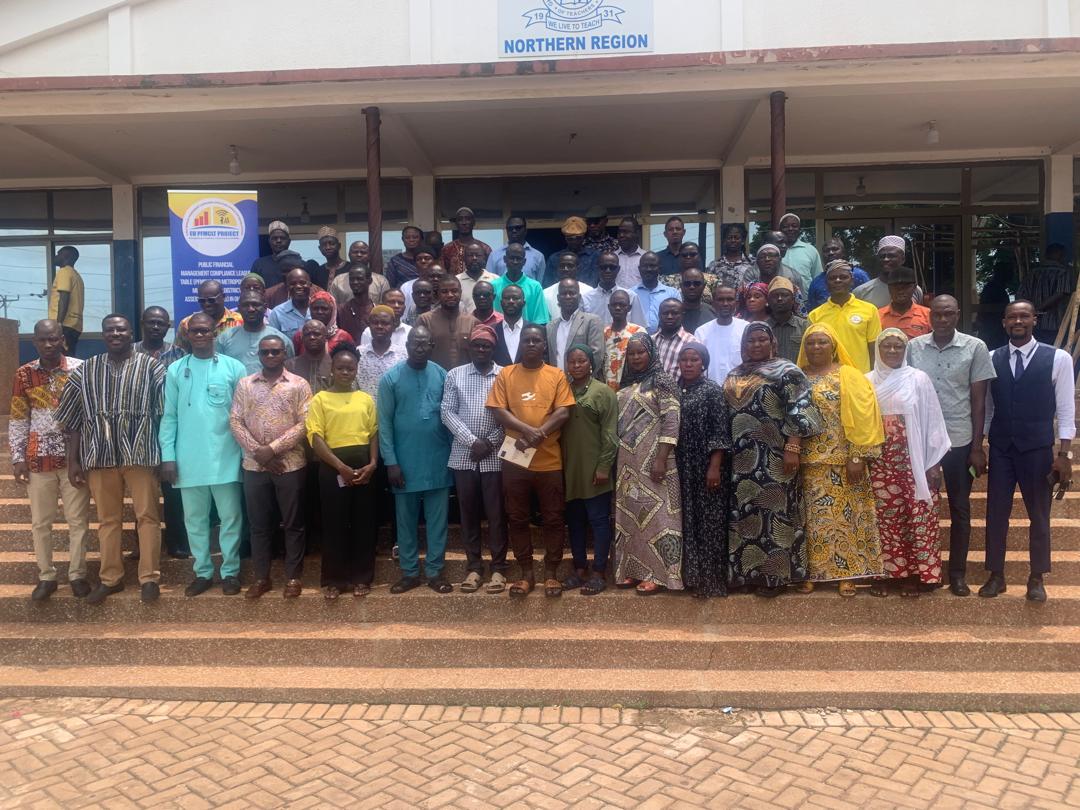
The Centre for Local Governance Advocacy (CLGA) has reported significant improvement in Public Financial Management Compliance among Ghana's local authorities, with the national average rising to 56.2%, the first time it has exceeded the 50% benchmark since the Public Financial Management Compliance League Table (PFMCLT) was introduced in 2023.
The Centre for Local Governance Advocacy (CLGA) has reported significant improvement in Public Financial Management Compliance among Ghana's local authorities, with the national average rising to 56.2%, the first time it has exceeded the 50% benchmark since the Public Financial Management Compliance League Table (PFMCLT) was introduced in 2023.
Speaking at the launch of the third edition of the PFMCLT 2025 Assessment Report at the British Council in Accra on 8 July 2026, CLGA's Deputy Executive Director, Hon. Gladys Gillian Naadu Tetteh, stated that the assessment achieved full national coverage for the first time, evaluating all 261 Metropolitan, Municipal and District Assemblies (MMDAs) across Ghana's 16 regions.
She noted that the national average increased from 22% in 2023 and 33% in 2024 to 56.2% in 2025. The number of Assemblies meeting or exceeding the 50% benchmark also rose substantially from 12 in 2024 to 153 in 2025. These comprised 3 Metropolitan, 73 Municipal and 77 District Assemblies.
Hon. Tetteh described the results as evidence that improvements in compliance are no longer confined to a small group of high-performing Assemblies but are becoming more widespread across Ghana's local government system.
She nevertheless highlighted continuing weaknesses, including incomplete meeting records, inadequate stakeholder engagement, limited use of the Ghana Electronic Procurement System (GHANEPS), and insufficient implementation of audit recommendations. She stressed that compliance could not be objectively verified without complete and reliable documentation.
Bia East District Assembly emerged as the best-performing Assembly nationwide, scoring 94.5% after rising from 175th position in 2024. Nkwanta South Municipal Assembly recorded one of the most significant improvements, moving from 261st position in 2024 to second place with 93.5%. Asokwa Municipal Assembly placed third with 92%. Other notable performers included Krachi Nchumuru District Assembly, which placed fourth after ranking 97th in 2024, and Adansi South District Assembly, which rose from 159th to eighth position. These improvements demonstrate the increasingly broad-based nature of progress in PFM compliance.
The Chairperson of Parliament's Public Accounts Committee and Member of Parliament for Atiwa East, Hon. Abena Osei-Asare, linked the League Table's findings to Ghana's broader public accountability efforts. Citing the Auditor-General's special audit report, she stated that approximately GH¢ 452 million had been recovered from disallowed expenditure identified in audit reports covering 2020–2023, as of 31 December 2024. She further indicated that the Public Accounts Committee would hold public sittings later in 2026 to examine the Auditor-General's latest report.
Hon. Osei-Asare described the PFMCLT as an important tool for shifting public financial management from the retrospective correction of irregularities to their prevention. She observed that Ghana's public financial management laws were generally adequate but that weak compliance continued to undermine their effectiveness.
CLGA Board Chairman Bernard Joe Apeah urged MMDAs to translate improvements in compliance into tangible development outcomes. He stressed that citizens expected their local authorities to deliver lasting improvements in their communities rather than serve narrow interests.
Representing the European Union at the event, Musah Mohammed reaffirmed the EU's support for CLGA's work in promoting transparency and accountability. He emphasized that sound public financial management was essential to strengthening citizens' confidence in local governance.
The event brought together Members of Parliament, representatives of the Auditor-General, the European Union, civil society organizations and top-performing MMDAs. CLGA and other stakeholders also called for stronger performance-based incentives, including consideration of targeted project support for consistently high-performing Assemblies.